The Sandinistas began redistributing property and made huge progress in the spheres of health and education. They won a decisive victory in 1984 elections, but their leftist orientation also attracted US hostility and drove them to turn to the USSR and Cuba.
 |
AT-A-GLANCE
Politics: Former Marxist guerrilla leader Daniel Ortega made a comeback in the November 2006 presidential race
Economy: Nicaragua is the second poorest nation in the Americas, after Haiti; former President Bolaños pursued market-friendly policies
International: The US has been vocal in its opposition to Ortega, who is seen as one of the main players in an increasingly assertive anti-US bloc in Latin America
 |
This set the scene for a US-sponsored counter-revolution, which saw Washington arm and finance thousands of rebels, or Contras, in order to carry out attacks on Nicaragua from bases in Honduras. The US also imposed trade sanctions and mined Nicaraguan harbours.
By 1990, when the Sandinistas were defeated in elections held as part of a peace agreement, Nicaragua's per capita income had plummeted and its infrastructure was in tatters.
Peace brought some economic growth, lower inflation and lower unemployment. But this was more than counter-balanced by the devastations of Hurricane Mitch in 1998, which killed thousands, rendered 20% of the population homeless and caused billions of dollars worth of damage.
Nicaragua's modest tourist industry - which had all but collapsed by the early 1990s - has enjoyed a revival. The country's attractions include wildlife-rich rainforests, volcanos, beaches and colonial-era architecture.
Managua
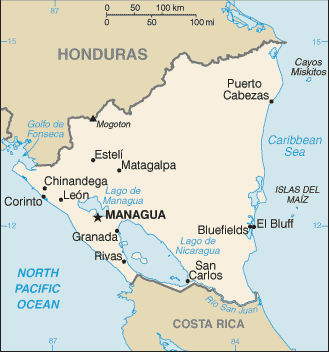
Managua (Spanish pronunciation: [maˈnaɣwa]) is the capital city
of Nicaragua as well as the department and municipality by the same name. It is
the largest city in Nicaragua in terms of population and geographic size.
Located on the southwestern shore of Lake Xolotlán or Lake Managua, the city
was declared the national capital in 1852.[2] Prior to its inception as the
capital city, the title had alternated between the cities of León and Granada.
The city has a population of about 2,200,000, composed predominantly of
mestizos and whites. Managua is the second most populous city in Central
America, after Guatemala City.
